|
Green for Go
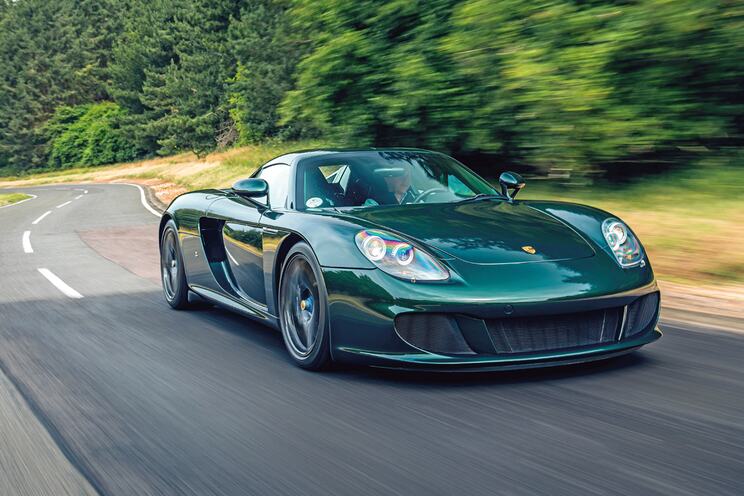
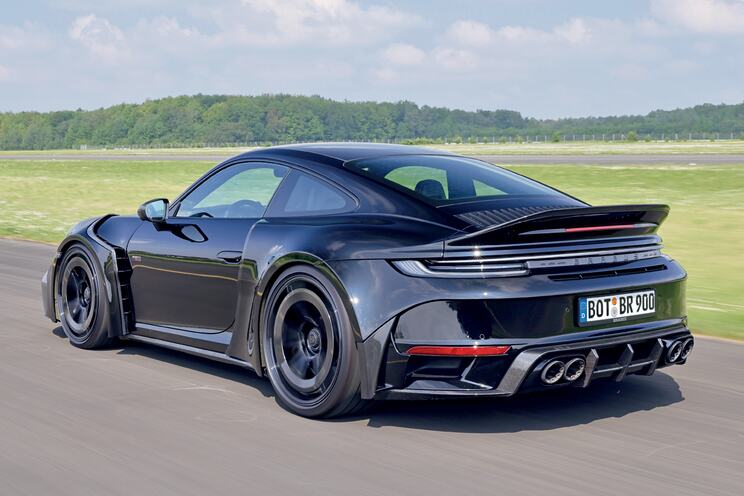
How a missed shift lead to the creation of the fastest alternative-fuel car in the world, the 9ff CT-78
Story and photos by Ian Kuah
When Porsche launched the Cay-man S in late 2005, the 295-bhp mid-engined coupe’s handling was the talk of the town. This immediately gave rise to speculation. Just how good it would be with, say, 911 horsepower?
In quick succession, tuned Cayman Ss with 3.8-liter motors, supercharged 3.4s, and even twin-turbocharger kits popped up. All gave Porsche’s reasonably-priced handling king the power to make it highly appealing to hardcore drivers. But what was a nice idea on paper quickly came up against the reality of simple economics — as well as the status of the Cayman in Porsche’s pecking order. After all, when push came to shove, how many real customers would spend GT3 money on a modified Cayman? In the real world, the answer seems to be precious few, so the bulk of personalized Caymans in private hands boast little more than bigger wheels, upgraded suspension systems, reflashed ECUs, and exhaust upgrades.
That didn’t prevent the tuners from creating outrageously modified Caymans, however. After all, such cars are always good launching platforms for more affordable components like wheels, suspension kits, and spoilers. In commercial terms, such items carry better profit margins than engine conversions — without the downside of a big horsepower motor conversion. If things go wrong, an engine failure is very expensive for the tuner if it’s under warranty, and very, very expensive for the customer if it is not.
That was certainly the case for Porsche tuner 9ff when a journalist from a well-known German car magazine missed a downshift and blew his 4.1-liter prototype up. “This was my own company car,” says 9ff boss, Jan Fatthauer. “So I was not best pleased.” For some months after that, the distinctive white Cayman ran with a mildly tuned stock motor before once again benefiting from the big bang of 9ff’s 435-bhp 4.1 flat six. “This big-displacement motor was very nice, but, as I am constantly test driving 600+bhp turbo motors in clients’ 911s, it felt underpowered.”
The idea of boosting the Cayman’s power came at the time when Fatthauer also had to make a decision about whether to enter 2007’s Nardo top-speed tuner shootout event organized by Germany’s Auto Bild magazine and Continental tires. 9ff has won the top-speed shootouts at Nardo before, so there wasn’t much to be gained from covering old ground.
“I wanted to do something really different for the 2007 event,” said Fatthauer. “With so much discussion today on environmental issues, I thought it would be the ideal opportunity to show that there is still plenty of life left in the internal-combustion engine as we know it and try for the speed record using E85 bio-ethanol fuel. My favorite Porsche motor is the water-cooled turbo, which is the basis for our GT9 motor. As our upgraded suspension has a lot of headroom, I decided it was worth the effort to drop one of my prototype GT9 motors into the Cayman.”
As 9ff’s GT9 sports car will also be a mid-engined car, most of the work to use the 997 Turbo engine and gearbox in this about-face configuration was already done. Though the main installation issues had been addressed, the 987 engine bay is tighter. Thus, ancillaries like the oil tank sit closer to the engine than in the GT9.
Where the 997 Turbo motor uses the tried-and-tested GT1 block as its core. Where the more extreme 900+bhp GT9 motor is taken out to 4.0 liters, however, the E85 Cayman variant remains 3.6 liters. “One reason was component cost,” explains Fatthauer. “The other was simply the fact that no one has run a bio-ethanol-fueled Porsche motor with such high power before. If we blew it up, we have lots of stock replacement parts lying around.” One area where some re-engineering work was needed to accommodate the new motor was at the rear end. This was due to the fact that the Cayman’s rear lower suspension arms are nearly parallel to the chassis, with just a small curve to provide clearance for the wheels.
“In this configuration, they partially occupy the same space as the turbos, so we had to fabricate new lower suspension arms that missed the turbos without compromising the suspension geometry,” says Fatthauer. “At the same time, we created exhaust manifolds and pipe work that did the other half of the component clearance job while optimizing gas flow.”
There’s no way a Cayman gearbox will take the power of this twin-turbo flat six, and, even if it could, it simply does not fit the GT1 block. Says Fatthauer: “The way around this is to literally turn the longer Turbo gearbox around and invert it. The gearbox is very strong, so the only modification needed for a Nardo top-speed record was a taller sixth gear. As the motor was built to safely sustain 7600 rpm, the car is now geared for 386 km/h (241 mph) in sixth.” The final piece in the gearbox puzzle is a GT2 limited-slip differential with a 40/65-percent lockup ratio.
|